Tuesday, October 26, 2010
Article: The Power of Xylitol
Since some of our monthly newsletters have included some information about Xylitol, we have found an interesting article for you to enjoy, all about Xylitol - what it is, the dental benefits of it and much more! Read the article here: http://teethforlife.co.za/images/Power%20of%20Xylitol%20p4-5.pdf.

Tuesday, October 19, 2010
Article: The History of the Toothbrush
The History of the Toothbrush
 From 5000 B.C. To Present
In a recent Lemelson/MIT survey, the toothbrush beat out the computer and the car as an invention that Americans said they couldn't live without. Boy, do we ever like our toothbrushes!
Read the full article here: http://www.huffingtonpost.com/thomas-p-connelly-dds/mouth-health-how-long-hav_b_683535.html

In a recent Lemelson/MIT survey, the toothbrush beat out the computer and the car as an invention that Americans said they couldn't live without. Boy, do we ever like our toothbrushes!
Read the full article here: http://www.huffingtonpost.com/thomas-p-connelly-dds/mouth-health-how-long-hav_b_683535.html
Wednesday, October 13, 2010
Link: Oral Health Evaluator
Click the link below to do a quick assessment of how well you take care of your teeth and gums:
http://www.webmd.com/oral-health/oral-health-evaluator/default.htm
As always, keep smiling!
http://www.webmd.com/oral-health/oral-health-evaluator/default.htm
As always, keep smiling!
Tuesday, October 5, 2010
Article: What's Really Lurking on Your Toothbrush?
The following is an article by Stephanie Watson on WebMD:
Do you know what's lurking on your toothbrush?
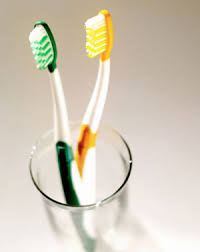
That's no big deal. Problems only start when there is an unhealthy balance of bacteria in the mouth. McCombs says.
"It's important to remember that plaque -- the stuff you're removing from your teeth -- is bacteria," says dentist Kimberly Harms, DDS, consumer advisor for the American Dental Association. "So you're putting bacteria on your toothbrush every time you brush your teeth."
Could Your Toothbrush Be Making You Sick?
Probably not. Regardless of how many bacteria live in your mouth, or have gotten in there via your toothbrush, your body's natural defenses make it highly unlikely that you're going to catch an infection simply from brushing your teeth.
"Fortunately, the human body is usually able to defend itself from bacteria," Harms says. "So we aren't aware of any real evidence that sitting the toothbrush in your bathroom in the toothbrush holder is causing any real damage or harm. We don't know that the bacteria on there are translating into infections."
Still, you should exercise some common sense about storing your toothbrush, including how close it is to the toilet.
Don't Brush Where You Flush
Most bathrooms are small. And in many homes, the toilet is pretty close to the bathroom sink where you keep your toothbrush.
Every toilet flush sends a spray of bacteria into the air. And you don't want the toilet spray anywhere near your open toothbrush.
"You don't store your plates and glasses by the toilet, so why would you want to place your toothbrush there?" McCombs says. "It's just common sense to store your toothbrush as far away from the toilet as possible."
You also wouldn't eat after going to the bathroom without first washing your hands. The same advice applies before brushing your teeth, McCombs says.
Toothbrush Storage Tips
Once you've moved your toothbrush away from the toilet, here are a few other storage tips to keep your brush as germ-free as possible:
Various products pledge to sanitize your toothbrush. Some say they kill bacteria with heat or ultraviolet light, germ-killing sprays, or rinses. Others have built-in antibacterial bristles.
Remember that even the best products won't kill all the germs on your toothbrush. At best, they'll kill 99.9% of the germs.
That means if you have one million bacteria on your toothbrush to start, you'll still have about 1,000 remaining when you're finished sanitizing, Harms says.
Some websites recommend putting your toothbrush into the microwave oven or dishwasher to sanitize it. Although these methods will kill some of the bacteria, they will probably damage your toothbrush in the process. It's better to just buy disposable brushes and throw them out.
When to Toss Your Toothbrush
The best way to limit the bacteria on your toothbrush is to replace it on a regular basis.
The American Dental Association recommends throwing out your toothbrush every three to four months. If the bristles become frayed, you're sick, or you have a weak immune system, throw it out even more often. If you use an electric toothbrush, throw out the head as often as you'd discard a disposable toothbrush.
Every time you're tempted to skip brushing and flossing your teeth, remember how many bacteria lurk in your mouth – and what they can do.
"It's bacteria that cause gum disease, and decay, and bad breath," Harms says. "Make sure you're brushing and flossing as often as possible to eliminate some of those bacteria." Rinsing your mouth with an antibacterial mouthwash before you brush can also help eliminate bacteria before they can get onto your brush.
Do you know what's lurking on your toothbrush?
Your toothbrush is loaded with germs, say researchers at England's University of Manchester. They've found that one uncovered toothbrush can harbor more than 100 million bacteria, including E. coli bacteria, which can cause diarrhea, and staphylococci ("Staph") bacteria that cause skin infections.
But don't panic. Your mouth wasn't exactly sterile to begin with.
Mouthful of Bacteria
"The bottom line is, there [are] hundreds of microorganisms in our mouths every day," says Gayle McCombs, RDH, MS, associate professor and director of the Dental Hygiene Research Center at Old Dominion University.
That's no big deal. Problems only start when there is an unhealthy balance of bacteria in the mouth. McCombs says.
"It's important to remember that plaque -- the stuff you're removing from your teeth -- is bacteria," says dentist Kimberly Harms, DDS, consumer advisor for the American Dental Association. "So you're putting bacteria on your toothbrush every time you brush your teeth."
Could Your Toothbrush Be Making You Sick?
Probably not. Regardless of how many bacteria live in your mouth, or have gotten in there via your toothbrush, your body's natural defenses make it highly unlikely that you're going to catch an infection simply from brushing your teeth.
"Fortunately, the human body is usually able to defend itself from bacteria," Harms says. "So we aren't aware of any real evidence that sitting the toothbrush in your bathroom in the toothbrush holder is causing any real damage or harm. We don't know that the bacteria on there are translating into infections."
Still, you should exercise some common sense about storing your toothbrush, including how close it is to the toilet.
Don't Brush Where You Flush
Most bathrooms are small. And in many homes, the toilet is pretty close to the bathroom sink where you keep your toothbrush.
Every toilet flush sends a spray of bacteria into the air. And you don't want the toilet spray anywhere near your open toothbrush.
"You don't store your plates and glasses by the toilet, so why would you want to place your toothbrush there?" McCombs says. "It's just common sense to store your toothbrush as far away from the toilet as possible."
You also wouldn't eat after going to the bathroom without first washing your hands. The same advice applies before brushing your teeth, McCombs says.
Toothbrush Storage Tips
Once you've moved your toothbrush away from the toilet, here are a few other storage tips to keep your brush as germ-free as possible:
- Keep it rinsed. Wash off your toothbrush thoroughly with tap water every time you use it.
- Keep it dry. "Bacteria love a moist environment," Harms says. Make sure your brush has a chance to dry thoroughly between brushings. Avoid using toothbrush covers, which can create a moist enclosed breeding ground for bacteria.
- Keep it upright. Store your toothbrush upright in a holder, rather than lying it down.
- Keep it to yourself. No matter how close you are to your sister, brother, spouse, or roommate, don't ever use their toothbrush. Don't even store your toothbrush side-by-side in the same cup with other people's brushes. Whenever toothbrushes touch, they can swap germs.
Various products pledge to sanitize your toothbrush. Some say they kill bacteria with heat or ultraviolet light, germ-killing sprays, or rinses. Others have built-in antibacterial bristles.
There's evidence that at least some of these products do effectively kill germs. But there's no real proof that using any toothbrush sanitizer will reduce your risk of getting sick.
If you choose to use one of these products, make sure that it has been reviewed by the FDA, which checks the validity of consumer health product marketing claims.Remember that even the best products won't kill all the germs on your toothbrush. At best, they'll kill 99.9% of the germs.
That means if you have one million bacteria on your toothbrush to start, you'll still have about 1,000 remaining when you're finished sanitizing, Harms says.
Some websites recommend putting your toothbrush into the microwave oven or dishwasher to sanitize it. Although these methods will kill some of the bacteria, they will probably damage your toothbrush in the process. It's better to just buy disposable brushes and throw them out.
When to Toss Your Toothbrush
The best way to limit the bacteria on your toothbrush is to replace it on a regular basis.
The American Dental Association recommends throwing out your toothbrush every three to four months. If the bristles become frayed, you're sick, or you have a weak immune system, throw it out even more often. If you use an electric toothbrush, throw out the head as often as you'd discard a disposable toothbrush.
Every time you're tempted to skip brushing and flossing your teeth, remember how many bacteria lurk in your mouth – and what they can do.
"It's bacteria that cause gum disease, and decay, and bad breath," Harms says. "Make sure you're brushing and flossing as often as possible to eliminate some of those bacteria." Rinsing your mouth with an antibacterial mouthwash before you brush can also help eliminate bacteria before they can get onto your brush.
Wednesday, September 22, 2010
Fun Quiz: White Teeth
Take our fun quiz below about white teeth! Don't forget to look down at the bottom for a free whitening coupon!
White Teeth Quiz
Answer each question either yes or no. At the end, click submit. The HIGHER your score, the more likely it is for your teeth to stain.Wednesday, September 15, 2010
Article: 6 Things to Never Reveal on Facebook
You may or may not know already that Madison Smile Solutions is now on Facebook. If you are a fan of our Facebook page, keep an eye out for special offers only Facebook fans can receive!
So many people are now on some kind of online social network, and it is amazing how people are using it to stay connected with people, even some they barely know. If you have a Facebook account, you may already know not to share certain things with just everybody on your profile. However, there are a few things many people over look. An article that was published on Yahoo! News today talked about 6 things you should never share on Facebook. If you missed it, keep reading, we've pasted it below:
The whole social networking phenomenon has millions of Americans sharing their photos, favorite songs and details about their class reunions on Facebook, MySpace, Twitter and dozens of similar sites. But there are a handful of personal details that you should never say if you don't want criminals — cyber or otherwise — to rob you blind, according to Beth Givens, executive director of the Privacy Rights Clearinghouse.
The folks at Insure.com also say that ill-advised Facebook postings increasingly can get your insurance cancelled or cause you to pay dramatically more for everything from auto to life insurance coverage. By now almost everybody knows that those drunken party photos could cost you a job, too.
You can certainly enjoy networking and sharing photos, but you should know that sharing some information puts you at risk. What should you never say on Facebook, Twitter or any other social networking site?
Your Birth Date and Place
Sure, you can say what day you were born, but if you provide the year and where you were born too, you've just given identity thieves a key to stealing your financial life, said Givens. A study done by Carnegie Mellon showed that a date and place of birth could be used to predict most — and sometimes all — of the numbers in your Social Security number, she said.
Vacation Plans
There may be a better way to say "Rob me, please" than posting something along the lines of: "Count-down to Maui! Two days and Ritz Carlton, here we come!" on Twitter. But it's hard to think of one. Post the photos on Facebook when you return, if you like. But don't invite criminals in by telling them specifically when you'll be gone.
Home Address
Do I have to elaborate? A study recently released by the Ponemon Institute found that users of Social Media sites were at greater risk of physical and identity theft because of the information they were sharing. Some 40% listed their home address on the sites; 65% didn't even attempt to block out strangers with privacy settings. And 60% said they weren't confident that their "friends" were really just people they know.
Confessionals
You may hate your job; lie on your taxes; or be a recreational user of illicit drugs, but this is no place to confess. Employers commonly peruse social networking sites to determine who to hire — and, sometimes, who to fire. Need proof? In just the past few weeks, an emergency dispatcher was fired in Wisconsin for revealing drug use; a waitress got canned for complaining about customers and the Pittsburgh Pirate's mascot was dumped for bashing the team on Facebook. One study done last year estimated that 8% of companies fired someone for "misuse" of social media.
Password Clues
If you've got online accounts, you've probably answered a dozen different security questions, telling your bank or brokerage firm your Mom's maiden name; the church you were married in; or the name of your favorite song. Got that same stuff on the information page of your Facebook profile? You're giving crooks an easy way to guess your passwords.
Risky Behaviors
You take your classic Camaro out for street racing, soar above the hills in a hang glider, or smoke like a chimney? Insurers are increasingly turning to the web to figure out whether their applicants and customers are putting their lives or property at risk, according to Insure.com. So far, there's no efficient way to collect the data, so cancellations and rate hikes are rare. But the technology is fast evolving, according to a paper written by Celent, a financial services research and consulting firm.
So many people are now on some kind of online social network, and it is amazing how people are using it to stay connected with people, even some they barely know. If you have a Facebook account, you may already know not to share certain things with just everybody on your profile. However, there are a few things many people over look. An article that was published on Yahoo! News today talked about 6 things you should never share on Facebook. If you missed it, keep reading, we've pasted it below:
6 Things You Should Never Reveal on Facebook
by Kathy Kristof
The whole social networking phenomenon has millions of Americans sharing their photos, favorite songs and details about their class reunions on Facebook, MySpace, Twitter and dozens of similar sites. But there are a handful of personal details that you should never say if you don't want criminals — cyber or otherwise — to rob you blind, according to Beth Givens, executive director of the Privacy Rights Clearinghouse.
The folks at Insure.com also say that ill-advised Facebook postings increasingly can get your insurance cancelled or cause you to pay dramatically more for everything from auto to life insurance coverage. By now almost everybody knows that those drunken party photos could cost you a job, too.
You can certainly enjoy networking and sharing photos, but you should know that sharing some information puts you at risk. What should you never say on Facebook, Twitter or any other social networking site?
Your Birth Date and Place
Sure, you can say what day you were born, but if you provide the year and where you were born too, you've just given identity thieves a key to stealing your financial life, said Givens. A study done by Carnegie Mellon showed that a date and place of birth could be used to predict most — and sometimes all — of the numbers in your Social Security number, she said.
Vacation Plans
There may be a better way to say "Rob me, please" than posting something along the lines of: "Count-down to Maui! Two days and Ritz Carlton, here we come!" on Twitter. But it's hard to think of one. Post the photos on Facebook when you return, if you like. But don't invite criminals in by telling them specifically when you'll be gone.
Home Address
Do I have to elaborate? A study recently released by the Ponemon Institute found that users of Social Media sites were at greater risk of physical and identity theft because of the information they were sharing. Some 40% listed their home address on the sites; 65% didn't even attempt to block out strangers with privacy settings. And 60% said they weren't confident that their "friends" were really just people they know.
Confessionals
You may hate your job; lie on your taxes; or be a recreational user of illicit drugs, but this is no place to confess. Employers commonly peruse social networking sites to determine who to hire — and, sometimes, who to fire. Need proof? In just the past few weeks, an emergency dispatcher was fired in Wisconsin for revealing drug use; a waitress got canned for complaining about customers and the Pittsburgh Pirate's mascot was dumped for bashing the team on Facebook. One study done last year estimated that 8% of companies fired someone for "misuse" of social media.
Password Clues
If you've got online accounts, you've probably answered a dozen different security questions, telling your bank or brokerage firm your Mom's maiden name; the church you were married in; or the name of your favorite song. Got that same stuff on the information page of your Facebook profile? You're giving crooks an easy way to guess your passwords.
Risky Behaviors
You take your classic Camaro out for street racing, soar above the hills in a hang glider, or smoke like a chimney? Insurers are increasingly turning to the web to figure out whether their applicants and customers are putting their lives or property at risk, according to Insure.com. So far, there's no efficient way to collect the data, so cancellations and rate hikes are rare. But the technology is fast evolving, according to a paper written by Celent, a financial services research and consulting firm.
Tuesday, September 7, 2010
Article: Michael Douglas and Throat Cancer - FREE OFFER

What is this disease? How is it treated? Based on what he's revealed, what do we know about Douglas's treatment and prognosis?
Read the article here: http://www.webmd.com/cancer/news/20100901/throat-cancer-faq
What can YOU do? From now until November 30th, if you come in for your cleaning (or any appointment!) you can get a FREE oral cancer screening just by mentioning this article!
Monday, August 23, 2010
Article: From the New York Times - Implants vs. Dentures
From The New York Times:
PATIENT MONEY: For Most, Implants Beat Dentures, for a Small Price

http://nyti.ms/aw9psf
PATIENT MONEY: For Most, Implants Beat Dentures, for a Small Price
Prosthetic teeth attached to the jaw with titanium screws are preferred for replacing lost teeth, but they’re expensive, and insurance coverage is usually minimal.
http://nyti.ms/aw9psf
Tuesday, August 17, 2010
Things to Know: Technology at Madison Smile Solutions
Madison Smile Solutions offers the newest in dental technology because we take great pride in offering you the highest level of care.
DIGITAL X-RAYS
Some people are concerned about their exposure to radiation during dental x-rays. This is understandable because some medical x-rays have relatively high radiation. You will be happy to know that 18 dental x-rays deliver 56,000 times less radiation to an unborn child than an upper GI series, 800 times less radiation than a chest x-ray, and 40 times less radiation than a typical day of background radiation.
To improve your quality of care, we have invested in a new, more precise way of looking into your mouth – digital x-rays. Advantages of digital x-rays include an 80 percent reduction in radiation over traditional dental x-rays, incredible precision, and a nearly instantaneous image that can be reproduced any number of times for insurance or referral purposes. Digital x-rays are also better for the environment, as they do not require chemicals for developing the image and can be stored on our computer, thus saving paper.
We have another very special piece of equipment that takes digital panoramic x-rays. The machine slowly revolves around the patient, taking an x-ray of the patient's full mouth and jaw. It helps us to see the condition of your jawbone, reveals deep cavities, and allows us to see any impacted teeth. This type of x-ray is recommended every three to five years.
DIAGNODENT – LASER DETECTION OF CAVITIES
This instrument is one of our favorite, and most essential, tools! The Diagnodent uses a small laser to detect cavities. It is completely safe and painless. The laser technology penetrates the enamel and is able to actually quantify the amount of decayed material at that particular location. Because it is able to detect decay earlier than other methods, the cavity can be taken care of with a much smaller restoration. In some cases where the decay has not yet gotten through to the pulp of the tooth, preventative treatment can entirely eliminate the need for a filling!
 TRIMIRA – ORAL CANCER SCREENING
Oral cancer kills one person every hour of every day. When oral cancer is detected early, patients have an 80 to 90 percent survival rate. However, because the majority of cases are discovered in the late stage, 40 percent of those diagnosed will die within five years. Oral cancer often develops with no pain or symptoms, and goes undetected until it has already metastasized to another location.
Our hand-held light helps us find oral cancer faster and more reliably. Trimira uses a variety of wavelengths of light to allow us to see abnormalities such as oral cancer that may not be apparent to the naked eye, allowing for much earlier detection of oral cancer. It uses the body's natural tissue properties as a tool for detecting suspicious tissue, which will show up abnormally under the different wavelengths.
Our hygienist, Trish, says, "I shine a blue light on the tissue and it fluoresces in a specific wavelength. It looks green when healthy tissue fluoresces and what we're looking for is the lack of that green color. The cancerous cells that have turned to the dark side, literally, show up dark and don't fluoresce green."
A visual oral inspection is part of every regular cleaning appointment with your hygienist, and we now recommend that all of our patients also have a Trimira oral cancer screening once a year. If your hygienist considers you to be at high risk for oral cancer, they may recommend Trimira at each of your regular 6-month cleaning appointments. You may opt to have a Trimira oral cancer screening at any time.
LASER DENTISTRY
Dr. Kaveh is trained in laser oral surgery and is excited to be able to offer laser surgery options to his patients. Tissue heals faster when a laser is used in oral surgery, which means you will be comfortable faster.
Advantages of Laser Dentistry
DIGITAL X-RAYS
Some people are concerned about their exposure to radiation during dental x-rays. This is understandable because some medical x-rays have relatively high radiation. You will be happy to know that 18 dental x-rays deliver 56,000 times less radiation to an unborn child than an upper GI series, 800 times less radiation than a chest x-ray, and 40 times less radiation than a typical day of background radiation.
To improve your quality of care, we have invested in a new, more precise way of looking into your mouth – digital x-rays. Advantages of digital x-rays include an 80 percent reduction in radiation over traditional dental x-rays, incredible precision, and a nearly instantaneous image that can be reproduced any number of times for insurance or referral purposes. Digital x-rays are also better for the environment, as they do not require chemicals for developing the image and can be stored on our computer, thus saving paper.
We have another very special piece of equipment that takes digital panoramic x-rays. The machine slowly revolves around the patient, taking an x-ray of the patient's full mouth and jaw. It helps us to see the condition of your jawbone, reveals deep cavities, and allows us to see any impacted teeth. This type of x-ray is recommended every three to five years.
DIAGNODENT – LASER DETECTION OF CAVITIES
This instrument is one of our favorite, and most essential, tools! The Diagnodent uses a small laser to detect cavities. It is completely safe and painless. The laser technology penetrates the enamel and is able to actually quantify the amount of decayed material at that particular location. Because it is able to detect decay earlier than other methods, the cavity can be taken care of with a much smaller restoration. In some cases where the decay has not yet gotten through to the pulp of the tooth, preventative treatment can entirely eliminate the need for a filling!
Oral cancer kills one person every hour of every day. When oral cancer is detected early, patients have an 80 to 90 percent survival rate. However, because the majority of cases are discovered in the late stage, 40 percent of those diagnosed will die within five years. Oral cancer often develops with no pain or symptoms, and goes undetected until it has already metastasized to another location.
Our hand-held light helps us find oral cancer faster and more reliably. Trimira uses a variety of wavelengths of light to allow us to see abnormalities such as oral cancer that may not be apparent to the naked eye, allowing for much earlier detection of oral cancer. It uses the body's natural tissue properties as a tool for detecting suspicious tissue, which will show up abnormally under the different wavelengths.
Our hygienist, Trish, says, "I shine a blue light on the tissue and it fluoresces in a specific wavelength. It looks green when healthy tissue fluoresces and what we're looking for is the lack of that green color. The cancerous cells that have turned to the dark side, literally, show up dark and don't fluoresce green."
A visual oral inspection is part of every regular cleaning appointment with your hygienist, and we now recommend that all of our patients also have a Trimira oral cancer screening once a year. If your hygienist considers you to be at high risk for oral cancer, they may recommend Trimira at each of your regular 6-month cleaning appointments. You may opt to have a Trimira oral cancer screening at any time.
LASER DENTISTRY
Dr. Kaveh is trained in laser oral surgery and is excited to be able to offer laser surgery options to his patients. Tissue heals faster when a laser is used in oral surgery, which means you will be comfortable faster.
Advantages of Laser Dentistry
- Minimal bleeding
- More controlled swelling
- Reduced postoperative infection/discomfort
- Less chance of infection
- Reduced time in dentist's office
- Less pain
- No noise (like a traditional dentist's drill)
- Faster healing
- A more sterilized environment (dental laser kills bacteria)
Kids: Your Child's First Dental Visit
 Parents frequently ask when they should bring their child in for their first dental visit. The American Academy of Pediatric Dentistry's recommendation is "first visit by first birthday". Your child should visit a dentist when the first tooth comes in, usually between six and twelve months of age. Early examination and preventive care will protect your child's smile now and in the future.
 FREE VISIT
Madison Smile Solutions believes in the importance of dental health in young children and offers a free exam for babies under one year of age. Call our office for details at 608-271-0961.
The term "nursing caries" (cavities) is used when discussing either bottle-feeding or breastfeeding activities that relate to infant caries. Another term is Early Childhood Caries (ECC). Please take advantage of our free exam for babies younger than 12 months old to help us partner with you in preventing dental caries.
Things to Know: Your First Cleaning Appointment
Your first cleaning appointment will take about an hour and a half. During that time we give your mouth a full physical examination including:
 DIGITAL X-RAYS
A full set of x-rays is an important part of a thorough dental examination. For most patients, "bite-wing" x-rays should be taken once a year and a full-mouth panoramic x-ray showing all of your teeth should be taken every three to five years.
Here are some of the reasons dentists rely on dental x-rays:

- -expose hidden dental decay
- -reveal an abscess, cyst, or tumor
- -show impacted or extra teeth
- -reveal bone loss from periodontal disease
- -help determine condition of fillings, crowns, bridges, and root canals
COMPREHENSIVE EXAM
We talk about any problems you may have experienced and if you have any specific concerns. We review the full mouth x-rays with you on our digital monitors. This makes it easy for all of us to see what is going on in your mouth. We note the existing condition of your teeth, record areas of concern, measure your gum tissue and evaluate for gum disease, screen for oral cancer, evaluate your smile, assess TMJ (your jaw joint) health, and chart occlusion (the way your teeth meet up with one another).
CLEANING
We will clean your teeth – also known as a prophylaxis. Your own toothbrush cannot remove the hardened build-up of plaque and calculus. This thorough cleaning takes care of that. We utilize an ultrasonic scaler that uses water and vibration to remove plaque, stain, and calculus from the teeth and flush it away from below the gumline.
If we find any decay or other matters that cannot be taken care of during this allotted time, we will discuss what we have found, and make appropriate appointments with you for further treatment.
We talk about any problems you may have experienced and if you have any specific concerns. We review the full mouth x-rays with you on our digital monitors. This makes it easy for all of us to see what is going on in your mouth. We note the existing condition of your teeth, record areas of concern, measure your gum tissue and evaluate for gum disease, screen for oral cancer, evaluate your smile, assess TMJ (your jaw joint) health, and chart occlusion (the way your teeth meet up with one another).
CLEANING
We will clean your teeth – also known as a prophylaxis. Your own toothbrush cannot remove the hardened build-up of plaque and calculus. This thorough cleaning takes care of that. We utilize an ultrasonic scaler that uses water and vibration to remove plaque, stain, and calculus from the teeth and flush it away from below the gumline.
If we find any decay or other matters that cannot be taken care of during this allotted time, we will discuss what we have found, and make appropriate appointments with you for further treatment.
Things to Know: Coming to Our Office
UNDERSTANDING YOUR CARE
Our staff wants you to understand what we are recommending for your oral health. We go over treatment plans, insurance coverage, and payment options with you. If you need more time to talk we are glad to schedule a time with the doctor or office manager for you to better understand your oral health needs. We can also help you strategize what may need to be done first and what might be able to wait a little longer. Just ask. We also encourage you to visit the links on this site to learn more about various treatments and the equipment we use.
 Prior to completing any major dental work, we can provide you with a written treatment plan to outline what needs to be done, the amount of time for each appointment and the costs of each phase. If you are interested, we review a variety of financing options including payment plans, MasterCard/Visa/Discover, and discounts for cash or check payments.
Our staff wants you to understand what we are recommending for your oral health. We go over treatment plans, insurance coverage, and payment options with you. If you need more time to talk we are glad to schedule a time with the doctor or office manager for you to better understand your oral health needs. We can also help you strategize what may need to be done first and what might be able to wait a little longer. Just ask. We also encourage you to visit the links on this site to learn more about various treatments and the equipment we use.
YOU WILL KNOW WHAT TO EXPECT
Prior to completing any major dental work, we can provide you with a written treatment plan to outline what needs to be done, the amount of time for each appointment and the costs of each phase. If you are interested, we review a variety of financing options including payment plans, MasterCard/Visa/Discover, and discounts for cash or check payments. CHANGING AN APPOINTMENT
At Madison Smile Solutions we try to carefully set up appointments to accommodate your schedule. If your needs change, we appreciate as much advance notice as possible. Please give us at least 24 hours notice if you need to change your appointment. Your time is reserved for you and cancellations with less notice may be charged a missed appointment fee.
Subscribe to:
Comments (Atom)